

Whether flying overhead or approaching Arctic glacial fjords by sea, the magnanimous ice-strewn scenes are jaw-dropping and bustling with marine life. It is the dynamic activity at the intersection of protruding glaciers into the sea that forces the physical mixing and geochemical reactions that control ecosystem livelihood. Fjord ecosystems respond with intense seasonal productive cycles and rampant carbon cycling, acting as leading carbon sink hotspots on our planet.
While fjords occupy only 0.1% of the ocean surface they may account for 11% of marine organic carbon burial (Smith et al., 2015). These small but mighty marine environments have sparse studies towards quantifying and monitoring one of the world's greatest natural carbon sinks.
Studying Arctic Carbon Cycling Under Sail
My marine research is conducted undersail. As a sailentist, my PhD research is culminating at the University of Maryland Center for Environmental Science (UMCES) Horn Point Laboratory yet my work originates through ongoing exploration with the nonprofit Ocean Research Project (ORP).
Since 2015, I have sailed north leading science expeditions along western Greenland with ORP's Captain Matt Rutherford at the helm. The Glacier-Oceans Mapping and Research Interdisciplinary Effort (GO-MARIE) is a decadal mission whereas a two-year campaign, in 2025 and 2027, is focused on improving the interpretation of carbon cycling across the polar glaciated coastline. Onboard the Schooner Marie Tharp, field operations began in 2025 funded in part by the Ocean Cruising Club, Society of Women Geographers, and ORP donors while technical and scientific partnership was established with LI-COR and renewed with Smithsonian Environmental Research Center.
Mapping Air-Sea CO2 Flux in Greenland
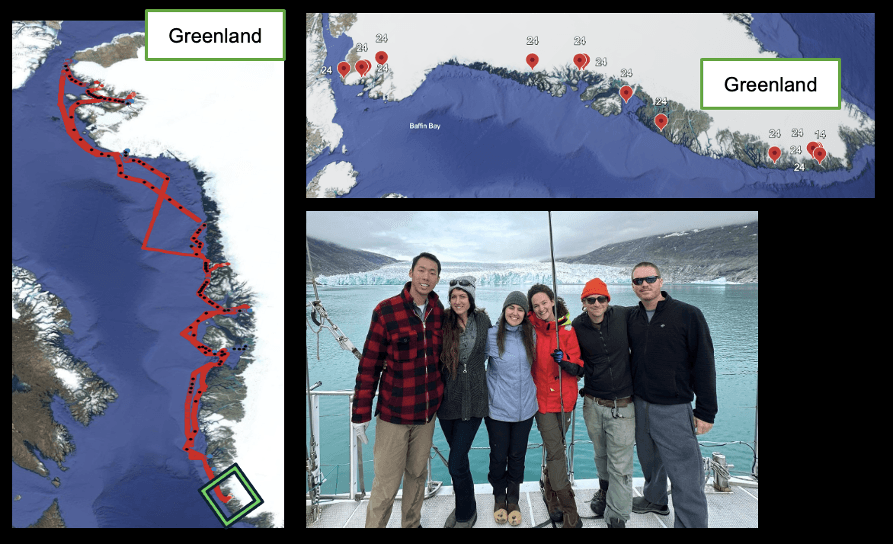
In 2025, the SRV Marie Tharp set off from Annapolis, Maryland, USA, to Greenland to first observe the summer distribution of dissolved inorganic carbon (DIC) - an indicator of ocean carbon uptake along west Greenland. Over the open-water season, sampling began in the subarctic, moving to the high-Arctic coastline as the sea ice broke free and allowed our ship to occupy glacial fjords, fjords defined by varying degrees of deglaciation. Within fjords, DIC and alkalinity were measured and combined to calculate seawater pCO2variation relative to the fjord's influence from glacier stage, current circulation and by latitude.
In Year 1 of the project, the objective was to also test and begin the development of the best practices for measuring onboard surface-water equilibrated gas and atmospheric CO2. At present further testing of coupling the LI-COR gas analyzers and equilibration system is in the works to prepare for an ambitious survey in 2027. In Year 2, the objective is to continuously measure surface-water equilibrated gas for a high-density spatial dataset of aquatic pCO2, and of atmospheric pCO2 to optimize the high-Arctic, data-sparse model products of NASA-ECCO Darwin's pCO2 and CO2 flux. These in situ measurements are invaluable for reinforcing model interpretation necessary for future monitoring of the changing role that the coastal Arctic plays as a global carbon trap.
In 2027, the emphasis on data collection will shift to directly measure the aquatic and atmospheric pCO2. This scientific objective will expand the observations necessary for high-spatial and high-temporal air-sea CO2 flux at key sites. The sites are results of the 2025 carbonate chemistry field observations and associated ECCO-DARWIN model outputs, sites that are identified for their significant carbon cycling activity or sites where the field observations and model greatly differ and require further field observations to improve the model. The goal is to utilize field-ready LI-COR technologies to best quantify the carbon uptake capacity of coastal and glacial fjords while underway.
Kuannersooq Fjord is located in southwest Greenland, about 245 km south of Greenland's capital city of Nuuk (Figure 1), a region with multiple sub-fjords defined by varying glacier stages. This is just one region that we occupied for obtaining water samples of carbonate-species. We respectfully acknowledge the Greenlandic and Danish governing authorities and local communities that approve our research activity.
Filling Arctic Carbonate Data Gaps with Ship-Based Measurements
Surface coastal pCO2 observational products remain sparse at high latitudes, hindering accurate air-sea CO2 flux of the high Arctic. Data-assimilative frameworks like ECCO-Darwin can mitigate these gaps by integrating in situ measurements (Carroll et al., 2020), particularly from ship-based LI-COR aquatic systems, tools essential for improving model validation and reducing uncertainty in seasonal Arctic CO2 flux estimates and carbon chemistry variation.
Measuring CO2, CH4, and Dissolved Inorganic Carbon (DIC)
Trace Gas Measurements with LI-COR Analyzers
A shipboard continuous system is in development to utilize the LI-7810 CH4/CO2/H2O Trace Gas Analyzer for aquatic gases, CO2 and CH4, and the LI-7815 CO2/H2O Trace Gas Analyzer for atmospheric CO2; both lightweight, robust trace gas analyzer cases retrofitted onboard SRV Marie Tharp in-prep for the 2027 campaign. Gas arrives at the LI-7810 inlet via an in-line Smithsonian-patented spherical equilibrator (Miller et al., 2019). Water along a through-hull flow pathway arrives at the equilibrator for the phase change from liquid to gas. Atmospheric gas also flows from a hose entry up top of the ship's mast then directly to the LI-7815 inlet after passing through the deck into the ship's lab.
DIC Measurements with the LI-5300A Analyzer
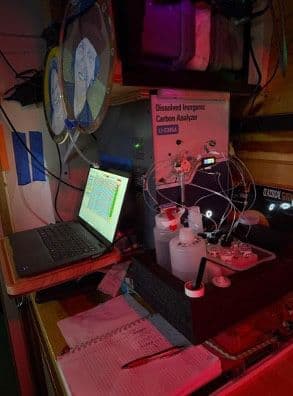
DIC samples (Figure 2) were run in near real time underway within 24 hours of collection using the LI-5300A Dissolved Inorganic Carbon Analyzer and the LI-7810. The LI-5300A was sturdily integrated into the lab counter. The LI-5300A, LI-7810, and LI-7815 data streams are monitored on multiple lab screens and electronic devices around the clock.
Field Sampling of DIC in Greenland's Glacial Fjords
We completed about 228 successful DIC sample measurements across western Greenland: along the continental shelf and within the glacial fjords between June and September.
- Water samples for DIC: Water samples were collected from the shipboard flow-through system and immediately filtered, sealed and refrigerated. Physical seawater properties were recorded at the time of sampling of sea water salinity and temperature. Certified standards were run before and after each sample batch was run to ensure instrument performance in measurement accuracy.
Next Steps for Arctic air-Sea CO2 Flux Monitoring
Further analysis of carbonate species, particularly DIC in comparison with the trace gas analyzer + equilibrator system setup, operation quality control checklist are to be re-established in pre-cruise lab and sea trial testing after several localized tests in Chesapeake Bay.
The exciting part of this research is amassing a critical near-real-time dataset for model comparison of CO2 gas flux while exploring icy seas amongst retreating glaciers. By conducting science undersail, we hope to improve our understanding of how global warming of the Arctic is change the role of coastal carbon capture as sea ice and land ice (glaciers) disappear. We stand to improve quantifying carbon uptake and addressing glacial fjords' role as a global carbon sink hotspot.
Learn more about the LI-5300A Dissolved Inorganic Carbon (DIC) Analyzer
LEARN MORE.png&w=3840&q=75)
References
- Carroll, D., Menemenlis, D., Adkins, J. F., Bowman, K. W., Brix, H., Dutkiewicz, S., Fenty, I., Gierach, M. M., Hill, C., Jahn, O., Landschützer, P., Lauderdale, J. M., Liu, J., Manizza, M., Naviaux, J. D.,
- Rödenbeck, C., Schimel, D. S., Van der Stocken, T., & Zhang, H. (2020). The ECCO-Darwin data-assimilative global ocean biogeochemistry model: Estimates of seasonal to multidecadal surface ocean pCO2 and air-sea CO2 flux. Journal of Advances in Modeling Earth Systems, 12, e2019MS001888. https://doi.org/10.1029/2019MS001888.
- Miller, A. W., Reynolds, A. C., & Minton, M. S. (2019). A spherical falling film gas-liquid equilibrator for rapid and continuous measurements of CO2 and other trace gases. PLOS ONE, 14(9), e0222303. https://doi.org/10.1371/journal.pone.0222303.
- Smith, R. W., Bianchi, T. S., Allison, M., Savage, C., & Galy, V. (2015). High rates of organic carbon burial in fjord sediments globally. Nature Geoscience, 8(6), 450-453. https://doi.org/10.1038/ngeo2421.
Author
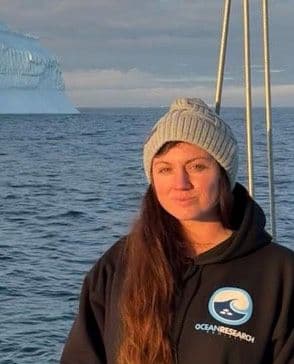
Nicole Trenholm is a PhD candidate at the University of Maryland Center for Environmental Science (UMCES), Horn Point Laboratory, and a Science Expedition Leader at the nonprofit Ocean Research Project (ORP), focusing on surveying carbon cycling along the Arctic's glaciated coastline. Nicole holds a bachelor's degree in geology and environmental sciences from La Salle University. Her professional experience includes contract roles for NOAA and NASA as a hydrographer and mariner.
NEVER MISS OUT ANOTHER POST
SUBSCRIBE TO OUR NEWSLETTERJOIN OUR COMMUNITY TODAY!