


Dissolved Inorganic Carbon (DIC) Analysis from Syringe-based Samples
Author: Mike Scaboo
Correspondence: envsupport@licor.com
Published: May 2026
Instruments: LI-5300A, LI-5350A, LI-5370A
Keywords: pore water, DIC, small samples
Abstract
The LI 53x0A Dissolved Inorganic Carbon (DIC) analyzers provide high precision DIC measurements for a wide range of aquatic samples, including seawater, freshwater, groundwater, and laboratory standards. This application note describes how to use the DIC analyzers to assess pore water samples. The syringe-based sampling modification described here extends the LI-53x0A’s capabilities by allowing direct analysis of small volume samples collected in syringes with a performance that meets and exceeds the specified analytical precision target of 0.2%
1 | Introduction
DIC in sediment pore water plays a critical role in the two‑way movement of carbon between the pelagic zone (the water column) and the benthic zone (the seafloor or lake bottom) in aquatic ecosystems. Accurate quantification of DIC is essential for understanding carbon burial, remineralization, and fluxes that influence the global carbon cycle and marine carbon dioxide removal (mCDR) strategies. However, DIC measurement from sediment pore water studies often require analysis of very small, difficult to handle samples that are prone to CO2 loss during transfer and storage.
The syringe based sampling modification described here extends the LI‑53x0A’s capabilities by allowing direct analysis of small volume samples collected in syringes. This approach minimizes sample handling and atmospheric exposure while maintaining analytical precision. For sediment research, it enables more efficient use of limited pore water volumes, supports higher resolution depth profiling, and improves confidence in measurements of DIC gradients and benthic carbon fluxes, expanding the utility of the LI‑53x0A for sediment biogeochemistry and carbon cycling studies.
2 | Components
A few extra pieces of hardware are needed to enable connection of the syringes to the rotary valve. The components can be purchased from LI-COR (part number 99543-059) or another supplier.
| Description | Part # |
|---|---|
| DIC Syringe Sampling Kit | 99543-059 |
| Barbed Fittings; PEEK 1/16” ID; ¼-28 flat (8) | 300-21142 |
| Tygon® Tubing, 5 cm each (8 pieces) | 222-21112 |
| Luer Fittings (8) | 300-21050 |
| Syringes with Luer connections | user supplied |
3 | Assembly
Follow these steps to install components required for DIC analysis of syringe samples.
-
Remove the PEEK knurls from sample ports D–K, ensuring washers remain in place.
-
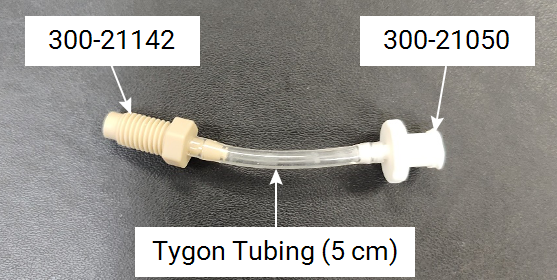
Attach Luer fittings to one end of each tubing segment.
-
Connect the opposite end of the tubing to the barbed fitting.
-
Install barbed fittings with tubing into ports D–K.
-
Connect sample syringes to the Luer fittings.
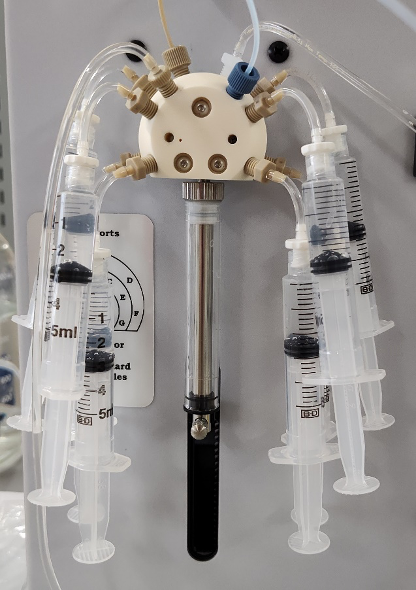
This configuration allows syringe-based samples to be connected directly to the rotary valve on the DIC system, as shown in Figure 1.
4 | Analytical Method - Instrument Settings
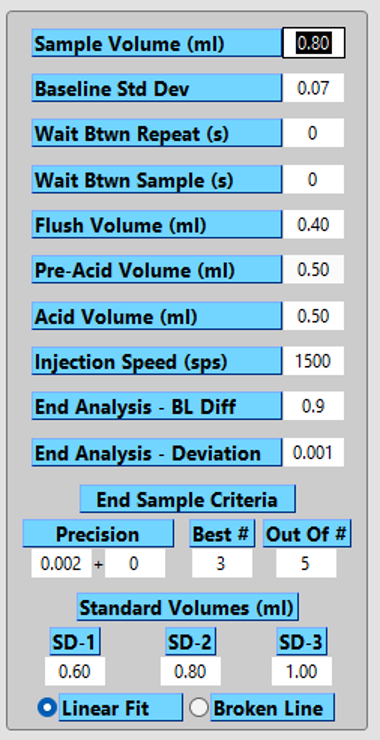
Apply the following settings in the interface:
-
Sample Volume: 0.8 mL
-
Flush Volume: 0.4 mL
-
Precision Threshold: 0.002 to 0.00. This setting relates to +/- 0.2% or 4 µM at 2000 µM.
The selected flush volume ensures greater than three full volume exchanges within the tubing, reducing carryover and improving measurement accuracy.
Apply the following settings to the standard volumes:
-
SD-1: 0.6 mL
-
SD-2: 0.8 mL
-
SD-3: 1.0 mL
These settings typically achieve a valid 3 of 5 replicate pass criterion when using 5 mL syringes. If this criterion is not met, verify proper syringe actuation with the system. Minor adjustments to precision thresholds may be required depending on system performance.
5 | Experimental Validation
The following procedure is an approach to validating the configuration and protocol. If you follow this test procedure and get comparable results, you can build confidence that the system is assembled properly and treating each sample the same.
5.1 | Materials
The following materials and components are required to validate the experimental conditions.
-
Certified Reference Material (CRM), Dickson Batch 218
-
Artificial seawater matrix
-
5 mL plastic syringes with Luer connections
5.2 | Procedure
Syringes were triple-rinsed with sample matrix and filled to 5 mL. Samples were immediately connected to the rotary valve and analyzed sequentially across ports D–K.
| Port | DIC (µmol/L) |
|---|---|
| D | 1799.87 |
| E | 1802.85 |
| F | 1803.60 |
| G | 1802.75 |
| H | 1798.91 |
| I | 1803.93 |
| J | 1796.15 |
| K | 1801.27 |
| Average | 1801.17 |
| ± | 2.70 |
| % | 0.15 |
The syringe-based sampling approach demonstrated excellent agreement across all eight ports, with a relative precision of 0.15%. This performance meets and exceeds the specified analytical precision target of 0.2%.
6 | Conclusions
This application demonstrates that syringe-based pore water sampling can be effectively integrated with an LI‑53x0A DIC analysis system to achieve high-precision measurements. The approach minimizes sample handling, reduces contamination risk, and provides a robust solution for sediment pore water studies and carbon cycling research.