


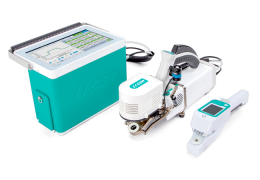
Comparing conductance measurements between the LI-6800 and LI-600
The LI-6800 and LI-600 provide stomatal conductance to water vapor (gsw) as a primary instrument output. While both are conceptually similar in the way that they derive gsw, there are some key differences between the two that are important when comparing data between them. These differences may lead to reported values that represent real biology, or pure instrument artifact. The following discussion highlights some of the more important considerations.
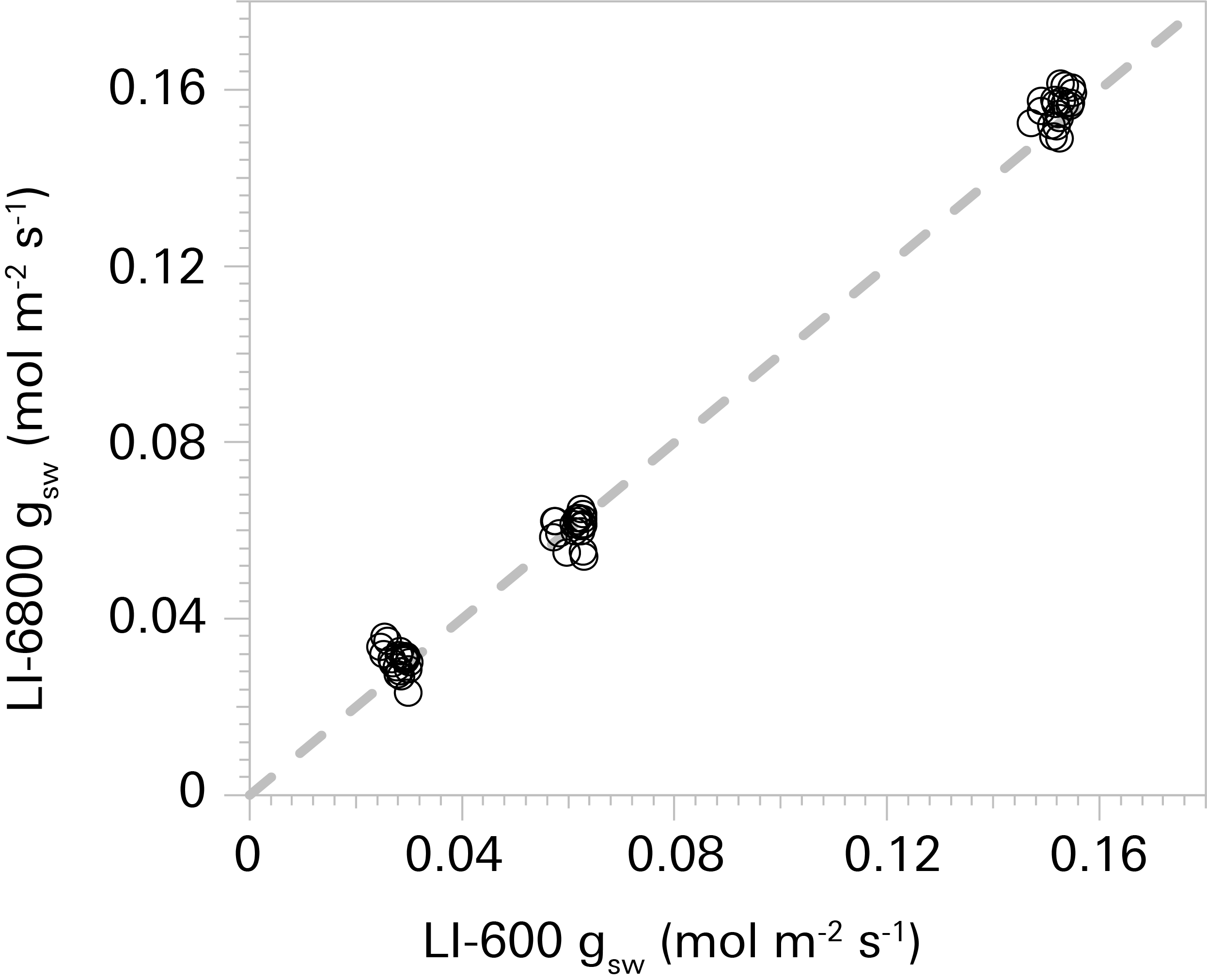
Why might conductance measurements be different between the LI-600 and LI-6800?
Stomatal ratio
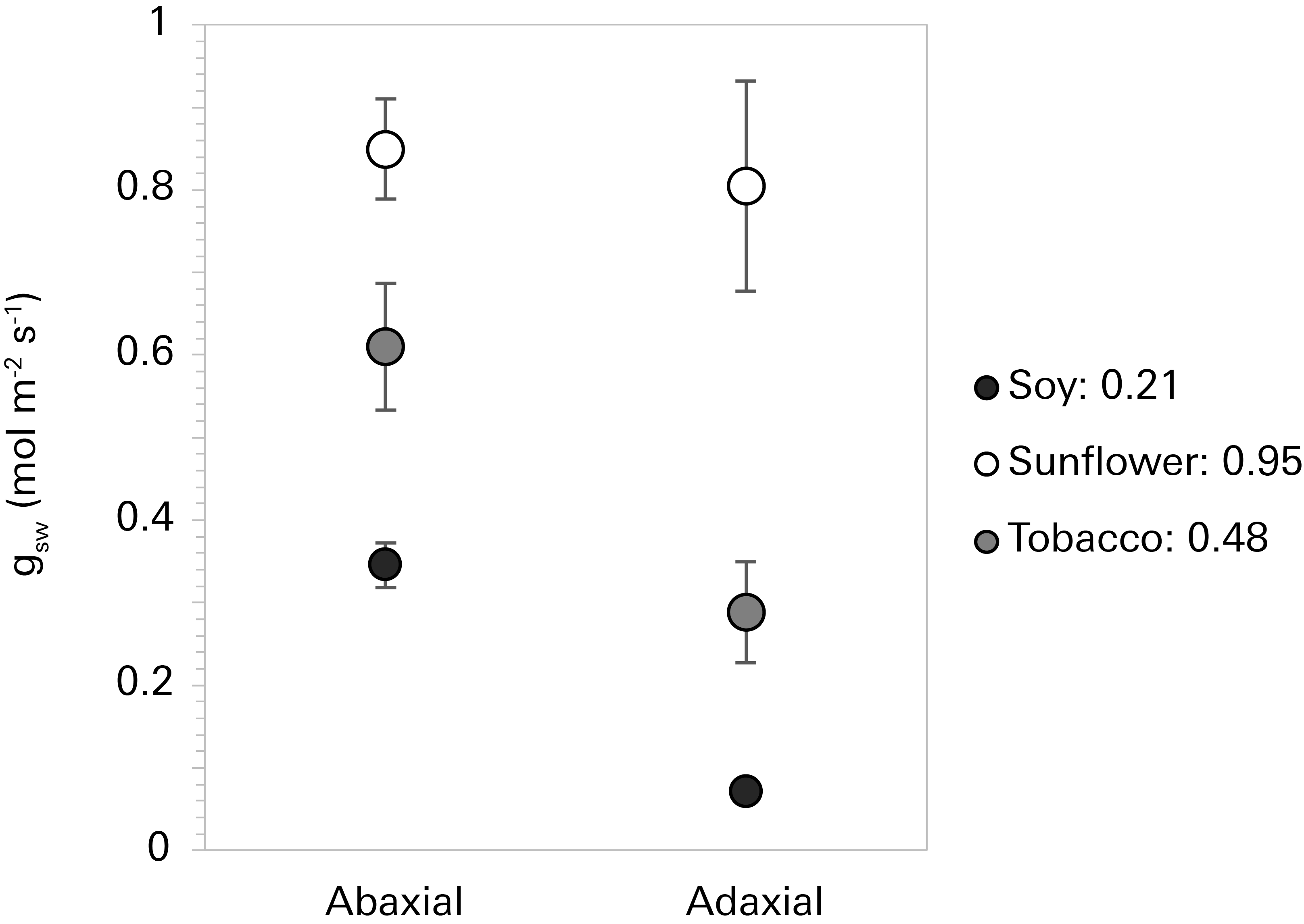
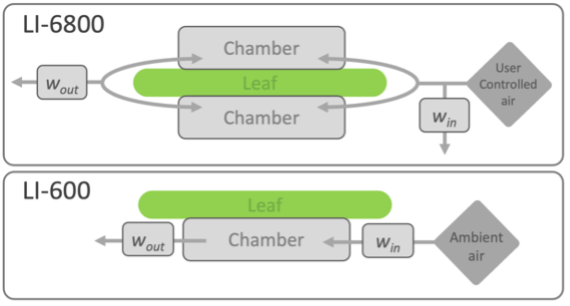
Stomatal ratio will have a significant impact on the relative magnitude of measurements between the LI-6800 and LI-600. This is because both instruments express conductance on a projected leaf area basis but differ in the number of surfaces that account for the projected area. The LI-6800 measures the integrated conductance from both leaf surfaces, whereas the LI-600 only measures conductance from one leaf surface (abaxial typically). In hypostomatous leaves conductance will be quite similar between the instruments. For all other cases, conductance will be larger in the LI-6800.
In the LI-6800, stomatal ratio is also a required input in the stomatal conductance calculation. The instrument assumes an even distribution of stomata on both leaf surfaces by default. Where stomata are not evenly distributed, the user must adjust the stomatal ratio parameter on the instrument to calculate the correct conductance. The LI-600 has no mathematical dependence on stomatal ratio.
- LI-600 Advantage: Measure the leaf in its normal orientation with LI-600 to get the abaxial conductance. Then flip it over to measure adaxial conductance. The ratio of the two conductances provides an estimate of the functional stomatal ratio. This value can then be used to set stomatal ratio on the LI-6800.
- LI-6800 Advantage: The LI-6800 measures integrated conductance from both leaf surfaces typically, but the 6800-01A fluorometer’s 6 cm2 aperture can be adapted to measure conductance from a single leaf surface with the single sided measurement kit (9968-313).
Sample area, heterogeneity, and spatial averaging
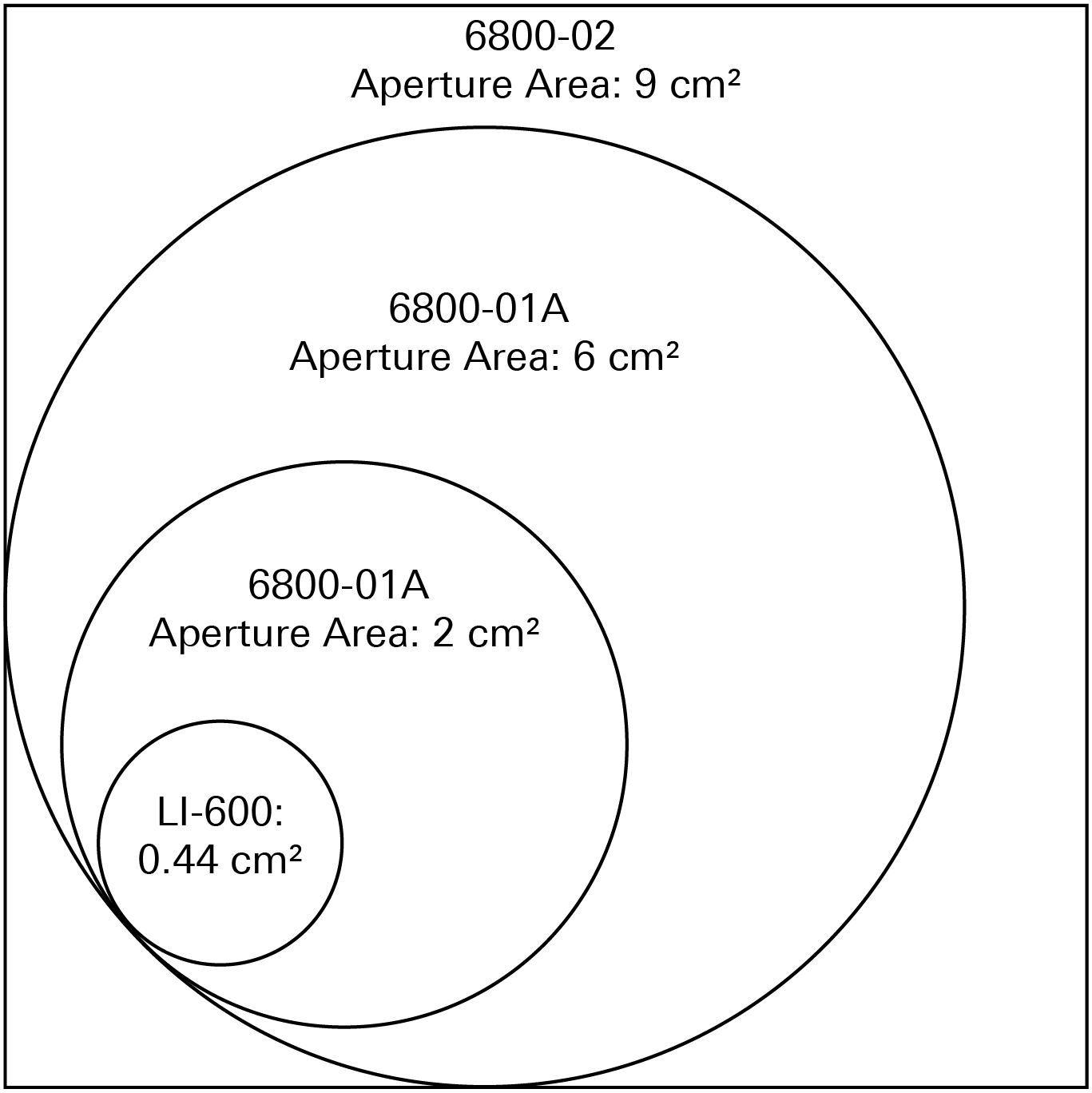
Stomatal conductance is averaged over the entire leaf area exposed in the chamber for both the LI-6800 and LI-600. However, the chamber aperture, and as such, the exposed leaf area is vastly different between the two instruments. Where stomata are evenly distributed on a leaf surface and their behavior is coordinated, this difference has little practical impact. Where stomata exhibit patchiness, aperture size can have a significant effect. Given the smaller aperture, patchiness will cause much greater variability in LI-600 data; Values may be larger or smaller than those measured by the LI-6800 on the same leaf.
- LI-600 Advantage: The small aperture of the LI-600 however, allows characterization of patchiness at or below the whole leaf level.
- LI-6800 Advantage: Where patchiness exists, single measurements from LI-6800 may provide a more representative picture of “whole leaf” behavior and be better suited to research focused at scales at or above the leaf level.
|
Measurement |
Adaxial |
Abaxial |
|---|---|---|
|
1 |
0.070 |
0.381 |
|
2 |
0.058 |
0.196 |
|
3 |
0.043 |
0.283 |
|
4 |
0.090 |
0.406 |
|
5 |
0.365 |
0.667 |
|
gsw from LI-600 (mean total) |
0.512 ±0.156 |
|
|
gsw from LI-6800 |
0.464 |
|
Stomatal response
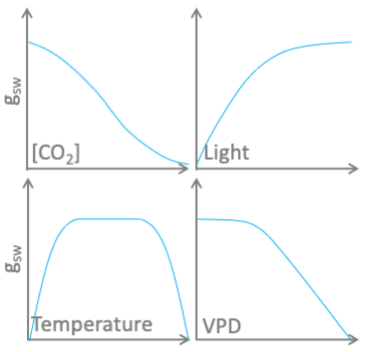
Stomata are known to exhibit responses to a number of environmental factors including light intensity, vapor pressure deficit, carbon dioxide concentration, and less commonly turbulence at the leaf surface. The time scale of response is typically different depending on direction, as well as species. Stomatal opening is generally slow, happening on time scales of a few minutes to tens of minutes. Stomatal closure is generally much faster, happening on time scales of a few seconds to a few minutes.
The LI-6800 and LI-600 differ dramatically in how they approach the environment the leaf is exposed to during measurements. The LI-600 provides no active control of any environmental parameter; the instrument is designed to measure the leaf under its current environmental conditions. Alternatively, the LI-6800 provides complete user control of the leaf environment. Where the LI-6800’s environmental controls are set to match the leaf’s ambient environment, the conductance measurement is analogous to that of the LI-600. Where one or more of its environmental controls is set to something different than what the leaf was exposed to prior to placing it in the chamber, stomatal response may be induced and the measured conductance must be consider with respect to the chamber, not the ambient, environment.
- LI-600 Advantage: Rapid measurements under ambient conditions with the LI-600 can be used for large scale screening programs.
- LI-6800 Advantage: The environmental controls of the LI-6800 allow for detailed characterization of environmental response from those individuals identified for further study in the screening program.
Measurement biases and sensor calibration
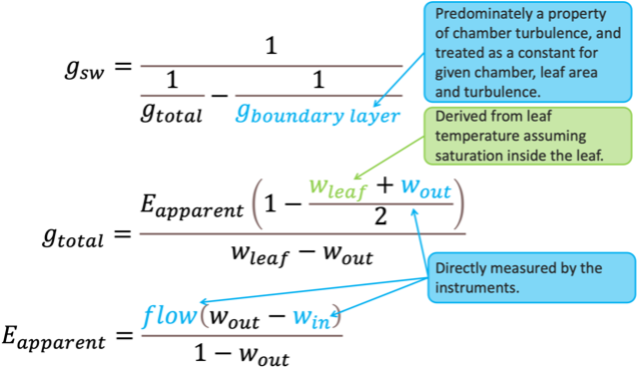
Conductance is a computed parameter from both instruments. It is not measured directly. It is derived from apparent transpiration, which in turn is derived from the flow of air through the chamber and the difference in the chamber’s incoming and outgoing water vapor concentrations. The calculation of apparent transpiration is relatively insensitive to errors in the absolute water vapor measurement because of internal cross calibration between the incoming and outgoing water vapor sensors. The derivation of conductance from apparent transpiration, is however much more sensitive to absolute errors. It relies on knowing the difference in water vapor concentration between the chamber (outgoing) and the inside of the leaf (derived from leaf temperature). Careful user calibration of the water vapor sensors in the LI-600 and LI-6800 can improve agreement in conductance measurements.
- LI-600 Advantage: The LI-600 features lower cost user-replaceable water vapor sensors that can be replaced every couple of years depending on the level of use. This eliminates the need to return the instrument for factory calibration.
- LI-6800 Advantage: The LI-6800 can be set to use point, weighted average, or mean integrated leaf temperature measurements. Where temperature may not be uniform across the leaf surface, use energy balance to get mean integrated leaf temperature. This can be done before or after data collection, by setting the appropriate energy balance option on the instrument or in the Excel data file.
Useful terms
- Adaxial: The upper leaf surface. The leaf surface on or facing the stem.
- Abaxial: The lower leaf surface. The leaf surface opposite or facing away from the stem.
- Amphistomatous: Possessing stomata on both leaf surfaces.
- Hypostomatous: Possessing stomata only on the abaxial surface.
- Epistomatous: Possessing stomata only on the adaxial surface.
- Stomatal ratio: The ratio of adaxial and abaxial stomatal densities.
- Apparent transpiration: The rate of water vapor loss from a leaf in a chamber. Abbreviated Eapparent.
- Stomatal conductance: The potential rate of water vapor loss. Apparent transpiration standardized by evaporative demand. Abbreviated gsw.
- Patchiness: Heterogeneity in stomatal density or stomatal conductance across a leaf surface.