
Choosing a soil moisture sensor is rarely just about the sensor. The measurements it takes, the output your data logger accepts, how far the cable needs to run, and how the probe will be installed all affect your decision-making process.
The LI-300 and LI-350 Soil Moisture Sensors are designed for different workflows. Both measure volumetric water content and soil temperature, but they differ in how they communicate with a logger, how measurements are converted, what additional measurements they take, and which configuration options are available.
Here's what those differences mean for your setup and how to install the sensor correctly after you selected the right one.
Key Takeaways
- Both sensors measure volumetric water content and soil temperature and share the same probe design and installation requirements.
- Choose the LI-300 when your data logger accepts analog voltage and your work does not require bulk electrical conductivity.
- Choose the LI-350 when you need SDI-12 output, bulk electrical conductivity, on-probe conversion, stored user calibrations, an M12 connector, or a longer cable run.
LI-300 vs. LI-350: What's the Difference?
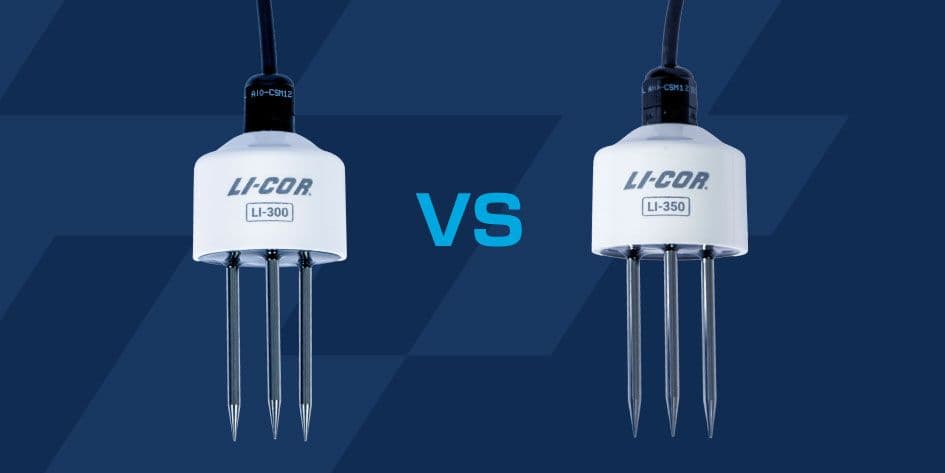
Both the LI-300 and LI-350 estimate volumetric water content and measure soil temperature. What makes them different are what they report, how they communicate, and where conversion takes place. These differences affect logger compatibility, programming, and other variables in your project. Neither sensor is automatically better; the right option simply fits your existing setup, goals, and environment.
| Feature | LI-300 | LI-350 |
|---|---|---|
| Measurements | Volumetric water content and soil temperature | Volumetric water content, soil temperature, and bulk electrical conductivity |
| Output | Analog voltage | SDI-12 digital output |
| Data Conversion | Analog voltages are converted to volumetric water content and soil temperature using provided equations | Reports converted measurements directly |
| Volumetric Water Content Calibration | Factory zero/span; mineral soil and soil-less coefficients provided for conversion | Factory calibrations for mineral soil and soil-less media; plus two user-defined custom calibrations |
| Termination | Bare leads | Bare leads or M12 connector |
| Cable Options | 5 m standard; bare-lead options to 40 m | 5 m bare lead or 1 and 5 m M12; bare-lead options to 75 m |
| Best Fit | Analog systems that need moisture and temperature | SDI-12 systems or projects that need bulk EC or more configuration options |
Looking for current configurations, cable lengths, and specifications? You can find more info here. If you are ready to confirm wiring or check out equations and commands for a specific installation, review the manual.
Which Sensor Fits Your Monitoring Setup?
While a quick comparison can help narrow down your choices, your setup ultimately makes the final decision. Use the five questions below to dive into the practical details of deployment and better understand what makes either the LI-300 or LI-350 right for you.
1. Which Output Works with Your Data Logger?
The LI-300 supplies one analog voltage to calculate soil moisture and another to calculate temperature. Your system must supply power, and your logger must read both channels and convert the voltages into the required units. If your system already uses analog measurements and logger-based calculations, then the LI-300 can fit into your workflow well.
The LI-350, meanwhile, communicates through SDI-12, allowing a compatible logger to request converted digital measurements. This can simplify programming across sites or logger programs. Before choosing it, though, first confirm that your logger supports SDI-12 and is configured to record the variables you need.
2. Do You Need Bulk Electrical Conductivity?
Bulk electrical conductivity is available only with the LI-350. It can add useful context when salinity, fertilizer solutions, or changing dissolved-ion conditions matter to your work. If your project only needs soil moisture and temperature, however, this additional measurement may not justify changing an established analog workflow. In that case, the LI-300 may give you the measurements you need with a simpler fit.
3. Should the Logger or Probe Convert the Measurements?
With the LI-300, your logger or downstream software converts analog voltage into volumetric water content and temperature. This keeps the equations and calibration coefficients in a workflow your team already manages, but those calculations must be configured correctly wherever the sensor is used.
With the LI-350, the probe can apply the selected calibration and report converted measurements through SDI-12. Raw values are still available when needed, but the probe can otherwise handle conversion before the data reaches the logger. That can reduce repeated setup and make the workflow easier to reproduce from site to site.
4. Which Connection and Cable Length Does Your Site Need?
Cable requirements are easy to overlook until you map the installation. Both sensors have a standard 5-meter bare-lead configuration. The LI-300's bare-lead options extend to 40 meters, whereas the LI-350's bare-lead options extend to 75 meters, and the sensor is also available with 1- or 5-meter M12 connections.
A longer cable or different connector matters only when it solves a site constraint. Be sure to check your logger location, cable route, termination, and power together so the sensor configuration fits the installation you have in mind.
5. Does Your Soil or Substrate Need Custom Calibration?
Both sensors have factory coefficient sets for mineral soil and soil-less media—such as coconut coir, peat moss, and potting soil. The coefficients must match the medium because the relationship between sensor response and volumetric water content changes with the material. Using the wrong set can produce measurements that are difficult to correct later.
The two sensors handle calibration differently, but calibration will never change what they measure. With the LI-300, your logger or downstream workflow applies factory coefficients to the analog output.
The LI-350, on the other hand, can use its factory calibrations or store two user-defined calibrations on the probe. Custom calibration may improve accuracy if your soil or substrate differs from the factory categories. Keep in mind, however, that developing one requires representative material, independent water-content measurements, and probe readings across several moisture levels; it is a deliberate project and not a simple field adjustment.
How Do You Install the LI-300 and LI-350?
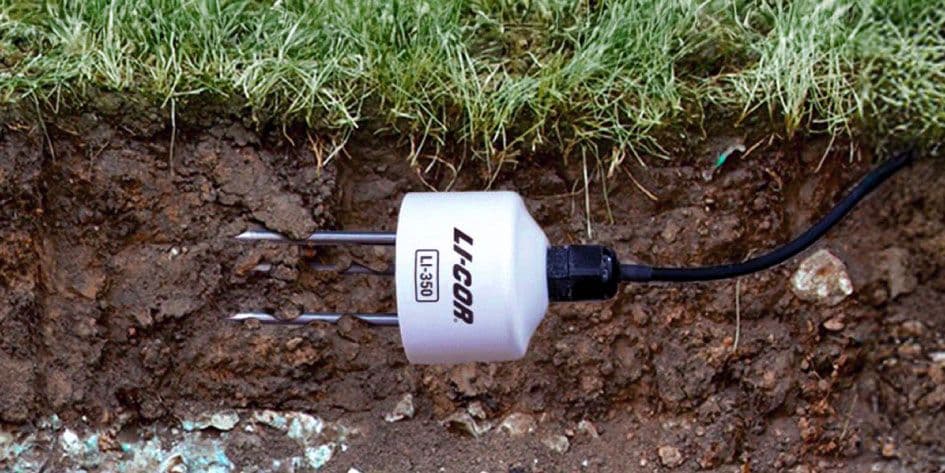
At this point, you should have a clear sense of which sensor fits your measurements and data-logging workflow. No matter which sensor you choose, both require proper installation. Because the sensors share the same probe design, they depend on good soil contact and a representative location.
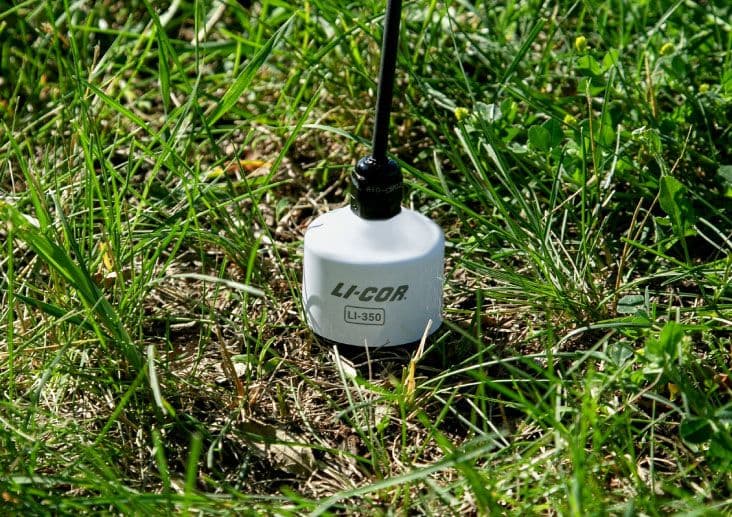
To start, each volumetric water content measurement is influenced by a volume around the probe, not a single point. When installing the LI-300 or LI-350, aim for a measurement volume of approximately 1.4 liters that extends beyond the tines and housing. Then press the full length of the tines into undisturbed material and avoid air pockets, rocks, roots, pooled water around only part of a tine, or movement after insertion. In pots and trays, leave enough space between the probe and the container wall for the surrounding measurement volume.
Installing multiple probes? Follow these guidelines.
Making the Final Decision
After considering each technical aspect, the choice between the LI-300 and LI-350 ultimately becomes simpler. If your system accepts analog voltage and needs volumetric water content and temperature, the LI-300 is likely the cleaner fit. If it supports SDI-12 and benefits from bulk electrical conductivity, measurements converted on the probe, user-defined calibrations, an M12 connector, or a longer supported cable run, the LI-350 is likely the stronger choice.
Ready to choose, or still have questions?
Request a quote for the LI-300 or LI-350 and talk through your measurements, logger, and site requirements with the LI-COR team.
REQUEST A QUOTE
Want the technical walkthrough first?
Watch the webinar Getting Started with the LI-300 and LI-350 for a closer look at measurements, communication, calibration, configurations, and field considerations.
NEVER MISS OUT ANOTHER POST
SUBSCRIBE TO OUR NEWSLETTERJOIN OUR COMMUNITY TODAY!