


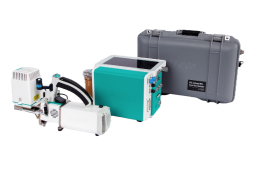
Using the LI-6878 Leaf Trace Gas Integration System
Getting started
The LI-7825 CO2 Isotope/NH3 Trace Gas Analyzer and other trace gas analyzers from LI-COR (hereafter referred to as TGA) can be combined with an LI-6800 to make leaf level measurements of mesophyll conductance using 13CO2 discrimination and/or fluxes of any of the trace gases measured by the TGA (12CO2, 13CO2, C18O2, and C17O2). Successfully integrating these two instruments requires both hardware and software.
The hardware is available as the LI-6878 Leaf Trace Gas Integration System. The LI-6800 software can be downloaded from Software Downloads.
What's what
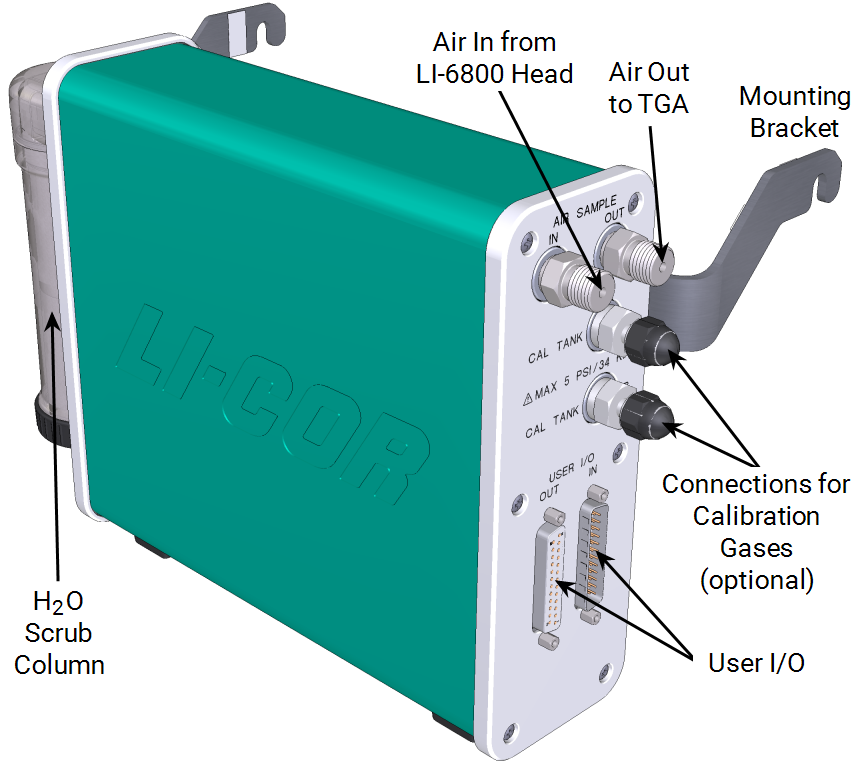
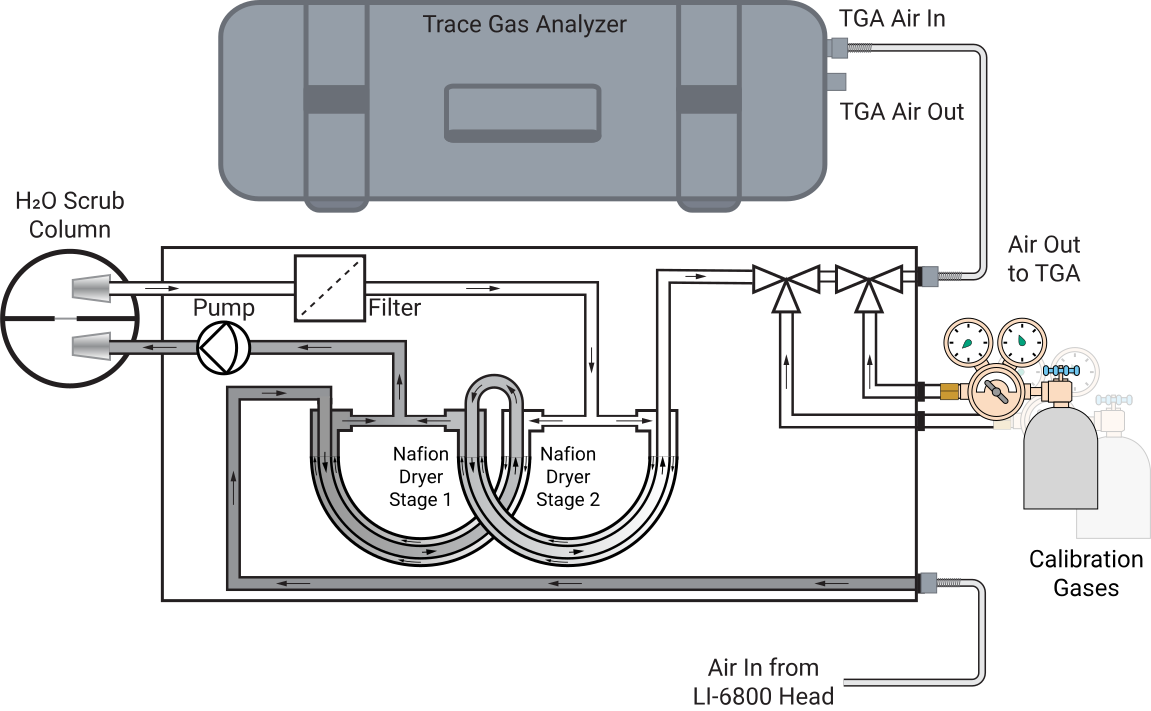
The kit includes an exhaust manifold (Figure 12‑1) that mounts to the front of the LI-6800 head (hereafter referred to as the LI-6850) and allows access to the exhaust air of the LI-6800 sample analyzer (or reference analyzer if in match mode). In this configuration, the LI-6800 air flow to the leaf chamber MUST exceed the intake flow rate of the TGA (nominally 250 sccm). A 2.4 meter length of tubing connects the manifold to the interface box (Figure 12‑2), which contains components to dry the air stream before it reaches the TGA via a 0.9 meter length of tubing. The interface box also allows for connection of up to two calibration tanks for the TGA. The internal pump and valves in the box are powered via the LI-6800 console auxiliary port. Drying is done by pumping a dry air stream around sections of Nafion tubing. The drying loop (Figure 12‑3) is dried via the a chemical column of desiccant (silica gel or Drierite). This column is the same design as is used on the LI-6800 console for soda lime and desiccant.
TGA head manifold
Part number 9968-428
The manifold connects to the head exhaust ports, providing connections for the air that is measured by the TGA.
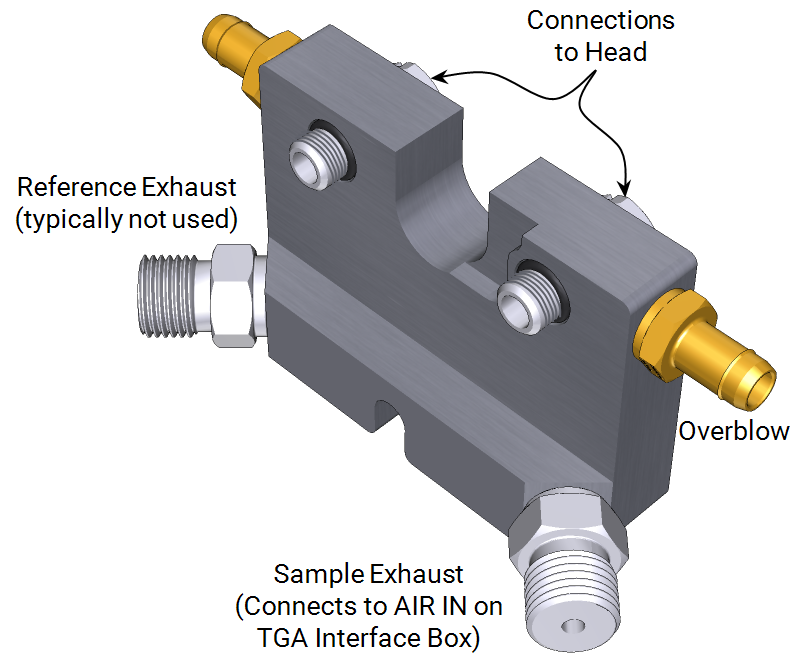
When the TGA manifold is connected to the head, the sample exhaust port provides air to the TGA for analysis.
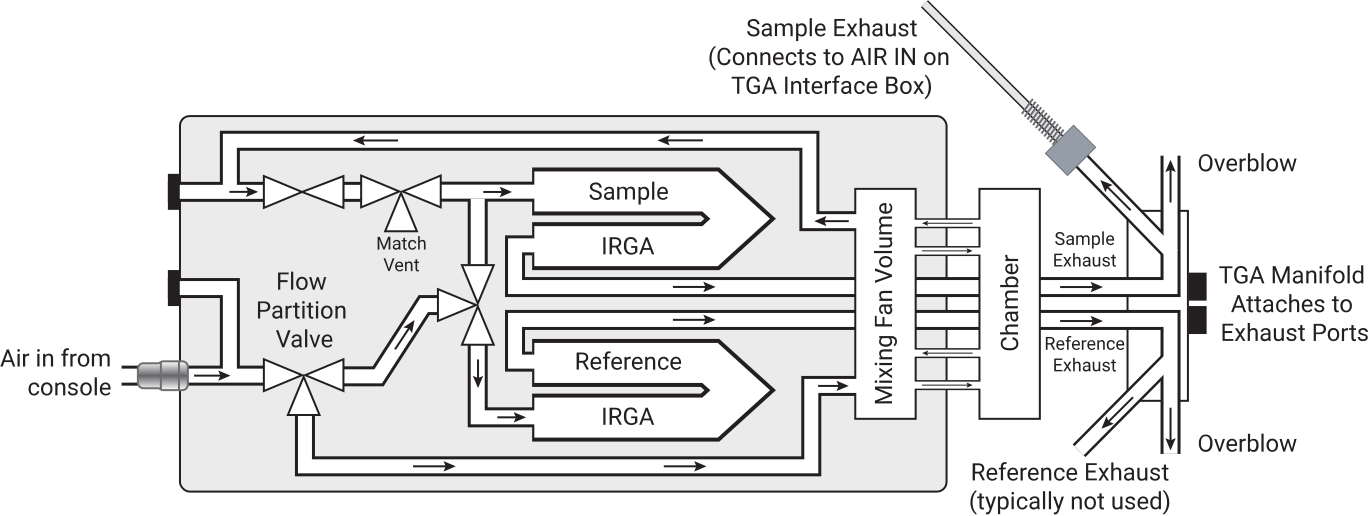
TGA interface box
Part number 9968-046
The interface box includes connections for sample tubing and tubing to the external TGA, as well as an internal sample drying system, with a pump and valves.
TGA interface accessories and spares kits
The Leaf Trace Gas Integration System includes the box and manifold described earlier, an Accessories Kit (9968-427), and a Spares Kit (9968-434).
| Description | Quantity | Part Number |
|---|---|---|
| TGA Interface Box | 1 | 9968-046 |
| TGA Head Manifold | 1 | 9968-428 |
| Accessories Kit | 1 | 9968-427 |
| Phillips Panhead Screw; M5x0.8 | 2 | 150-22006 |
| Washer; M5, 15 mm OD | 2 | 159-14460 |
| Washer; 6 mm ID, 15 mm OD, 4 mm Thick | 2 | 159-22007 |
| Bushing; 3 mm ID, 8 mm OD | 2 | 161-21916 |
| Ralston Adapter to 1/4" Tube | 1 | 300-21920 |
| Ralston Quick-test Hose; 1.8 m | 1 | 300-21921 |
| Ralston Quick-test Hose; 2.4 m | 1 | 300-22150 |
| 25-pin M-F Cable; 30 cm | 1 | 392-21812 |
| RJ45 Network Cable; 2 m | 1 | 616-06116 |
| Cap Nut M8x1.25; black; installed | 2 | 157-21957 |
| Cap 1/2-20; blue; installed | 2 | 620-21951 |
| Spares Kit | 1 | 9968-434 |
| Disposable Air Filter | 1 | 300-01961 |
| Brass Hosebarb; 1/8 ID-to-10-32; O-ring Seal | 2 | 300-17717 |
| H2O Scrub Column | 1 | 9968-194 |
Software
TGA integration is supported by Bluestem OS v2.2 and newer, which is available from Software Downloads. Additions to the LI-6800 firmware are required to handle the various tasks associated with integrating these two instruments. Installing the software describes how install the software and activate the TGA options. Below is an overview of what the new software provides.
LI-6878 Leaf Trace Gas Integration System control
The TGA flow source, as selected by the interface box (LI-6850 head, Tank A, or Tank B), can be manually or programmatically selected, as can the box drier controls (pump on/off and pump speed).
TGA communication
Ethernet communication between the LI-6800 and the TGA is initiated from the LI-6800 console using the TGA IPv4 address or host name. Once connected, 1 Hz data is continuously monitored by the LI-6800 and packaged into various data groups (TGA data and groups), allowing the TGA-based measurements and computations to be logged, graphed, viewed in the Data Dictionary, etc., along with all the usual LI-6800 data.
TGA calibration
With the required tank(s) and the LI-6878 Leaf Trace Gas Integration System, the TGA can be calibrated for zero (zero tank), span (one span tank), or span and offset (two span tanks with appreciably different CO2 concentrations). These tank measurements and calibrations can be triggered manually or under program control.
Isotopic calibration
A critically important feature of the LI-6800 TGA integration software is the isotopic calibration for background concentration (Isotopic calibration details). This is what ensures accuracy of trace gas measurements at concentrations beyond those provided by calibration tanks. The LI-6800, using its CO2 controller, often operates over quite a range of CO2 concentrations, such as when performing a CO2 response curve. When the source of that CO2 is unchanging (e.g. a single CO2 cartridge), it can be assumed that—at least over the short term—the isotopic fraction of that CO2 is also unchanging. That is, you would expect to measure the same δ13C value at any concentration. But that does not happen in practice without applying corrections.
The isotopic background calibration is done by measuring δ13C, δ18O and δ17O over a wide CO2 concentration range. The correction curve that is generated from this action provides a measurement of the offset in isotopologue concentration as function of 12CO2 concentration. The correction curve goes through zero at the basis concentration, which is the CO2 concentration where the TGA has been most recently calibrated.
Isotopic cals should be done daily. Subsequent adjustments are made to these cals: for example, any time the LI-6800 is in match mode long enough to collect a stable TGA reference data set, the isotopic cal is updated with this new data (see Adjustments).
Matching for mesophyll conductance and flux computations
The heart of the LI-6800 gas exchange computations is the difference between sample and reference (i.e., air leaving the chamber compared with air entering the chamber). Since the TGA has only a single channel, an important role of the new software is to make, as seamlessly as possible, the single measurement TGA cell appear to be a dual cell TGA, having both sample and reference values. The reference values, of course, must come during match mode, so the LI-6800’s match mode firmware now has provisions for optional TGA “matching”.