


Operational guidelines
Designing a successful measurement protocol that combines the TGA with the LI-6800 adds some important considerations and constraints. We review them below.
Measurement considerations
Take your time
This measurement is not fast; it is a deep dive into plant physiology. While it may test your patience, your experimental outcomes will be better if you bring all of your patience to the measurement. The efficacy of the Nafion equilibrator may be reduced (requiring even more time) at high temperatures and when the interface box is exposed to direct sunlight. You may have faster equilibration if you shade the interface box to help control its temperature.
Start with fresh scrub chemicals
The silica gel beads in the drying columns on the console and TGA manifold should be fresh. If they are not fresh, the system will take more time to control water vapor in the air stream, which may further test your patience while simultaneously worsening experimental outcomes. Avoid the situation with fresh (or refreshed) silica beads, indicated by the bright orange color.
Leaf area and chambers
Isotopologues and trace gases give very small differentials. The 6800-18 Large Leaf Chamber provides the largest leaf area and therefore, the largest differentials between sample and reference measurements. The 6800-01A Fluorometer Chamber and 6800-12A Small Leaf Chamber are both compatible with the LI-6878 Leaf Trace Gas Integration System, but you may find that the data are hard to interpret due to the small differences.
TGA warmup time
Unlike the LI-6800, the TGA can take a many hours (even a day) to reach stability after a powering up, so consider leaving it powered continuously during a measurement campaign. Sleep mode is useful in this case. While in sleep mode, the TGA stays warmed up but does not log data.
TGA is single channel
LI-6800 users are used to having two analyzers simultaneously monitoring sample and reference air streams. Since the TGA is a single channel, and there is only one of them attached (in this present design), it is important to keep in mind that only one air stream at a time is being monitored by the TGA. In normal (non-match) operating mode, the TGA will receive air from the chamber or 'sample' air. Only during matching does the TGA receive the 'reference' air stream. Thus, matching gains importance, and is more fully discussed below.
TGA input requires drying
The goal with the TGA interface box scrubbing is not to completely dry the air stream but to bring H2O to a reduced and stable level. This is because the LI-6800 reference and sample air streams usually have very different H2O mole fractions, so the scrub box needs to minimize H2O differences when swapping between the air streams.
Keep in mind that it typically takes nearly 30 minutes to get the scrub box dried down adequately to begin measurements, so allow time for this prior to performing the Isotopic Cal and taking measurements.
Matching and the TGA
LI-6800 matching provides an opportunity for the TGA to measure reference instead of sample air. This information is used for two purposes:
-
Match mode updates in the reference side of the TGA_meas data group (TGA_meas).
This happens regardless of whether or not TGA stability is achieved in match mode. If TGA stability is achieved, the TGA reference values will be the most recent stable values measured during the match. Otherwise, the reference values will simply be the last measurement during the match.
-
For the LI-7825 / LI-8825, the isotopic cal curve can be updated (Adjusting for a match).
Flow Rate
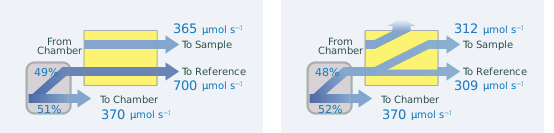
The TGA has a pump that samples from the air flow provided to it, so that supplied flow needs be above about 200 μmol s−1, or part of what the TGA measures will be room air. To be safe, we start warning at flows < 250 μmol s−1. When match mode is entered, the reference air is divided between reference and sample IRGAs, so the air going to the TGA (from the sample cell) will be about 1/2 the reference flow rate during normal operation (Figure 12‑36). Therefore, it is important to keep the reference flow above about 500 μmol s−1 (and sample above 250 μmol s−1) during normal operation. If you find the reference flow to be too low, the simple fix is to increase the pump speed to the next available level (e.g. Medium).
Time
A match that will allow enough time to get stable TGA information (to adjust the isotopic cal) will typically take 2x or 3x longer than a normal match where just the LI-6850’s CO2 and/or H2O is being adjusted (Adjusting for a match). Here’s why. When match is entered, it takes:
-
Initially, several seconds for the new air to flush out the old air in the TGA (depends on flow rate).
-
Then, the averaging-time number of seconds to fill the statistics buffer with new data.
-
Finally, however long it takes to reach stability, which is defined to be at least three successive readings for which the absolute rate of change of CO2 with time is lower than the threshold you’ve selected.
Triggering a Match
Whether a TGA match will be part of a log event is determined by the Match @ log radio button settings on the Status page (Figure 12‑37). The choices are Never, Always, and If CO2. The latter couples TGA matching to CO2 matching.
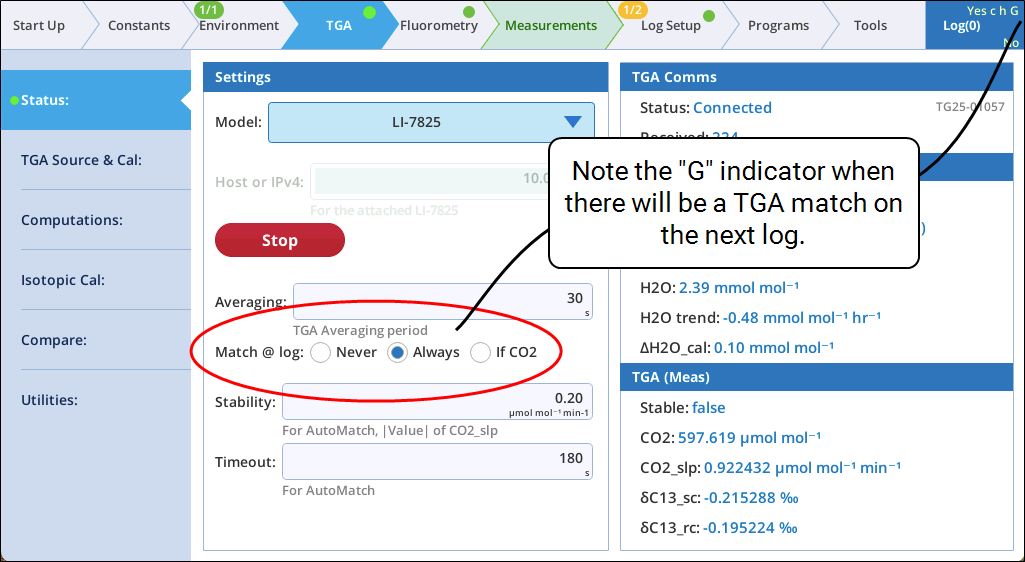
Note that all of these settings can also be set from a running background program (BP), using the SETCONTROL command (SETCONTROL additions). In particular, the SETCONTROL option for adjusting the Match setting is presented in TGA:Match.
The three settings explained:
-
Never doesn’t prevent matching. It simply means that matching will only last as long as necessary to accomplish the CO2 and/or H2O match. The default timeout in those circumstances is 40 seconds. It is unlikely that TGA stability will be achieved, and the TGA reference reading ultimately logged will reflect the final one taken during match.
-
Always means matching, when it happens, will always be extended until TGA stability occurs, up to the timeout time specified in Figure 12‑37. This makes it quite likely that a stable reference reading will be achieved.
-
If CO2 will do a TGA match (i.e. extend the timeout time) only if CO2 matching is to be done.
After the Match
LI-7825/LI-8825: When TGA stability is achieved during a match (regardless of whether Never, Always, or If CO2 were selected), that stable reference data set (let’s abbreviate it SRDS) is used for the following sequence of events:
-
The SRDS is used to update the Isotopic calibration (see Isotopic calibration details).
– If the match was triggered by a log –
-
The SRDS is recomputed with the updated isotopic cal. This makes the isotopic values match the target values.
-
The reference part of the TGA_meas group is replaced with the SRDS.
-
The sample part of the TGA_meas group is recomputed using the updated isotopic cal.
-
The freshly recomputed TGA_meas group is logged, and the reference part remains unchanged until match mode is entered again.
Other TGAs: The reference readings are either the last readings obtained while in match mode, or the latest SRDS obtained during the match.
Early Matching
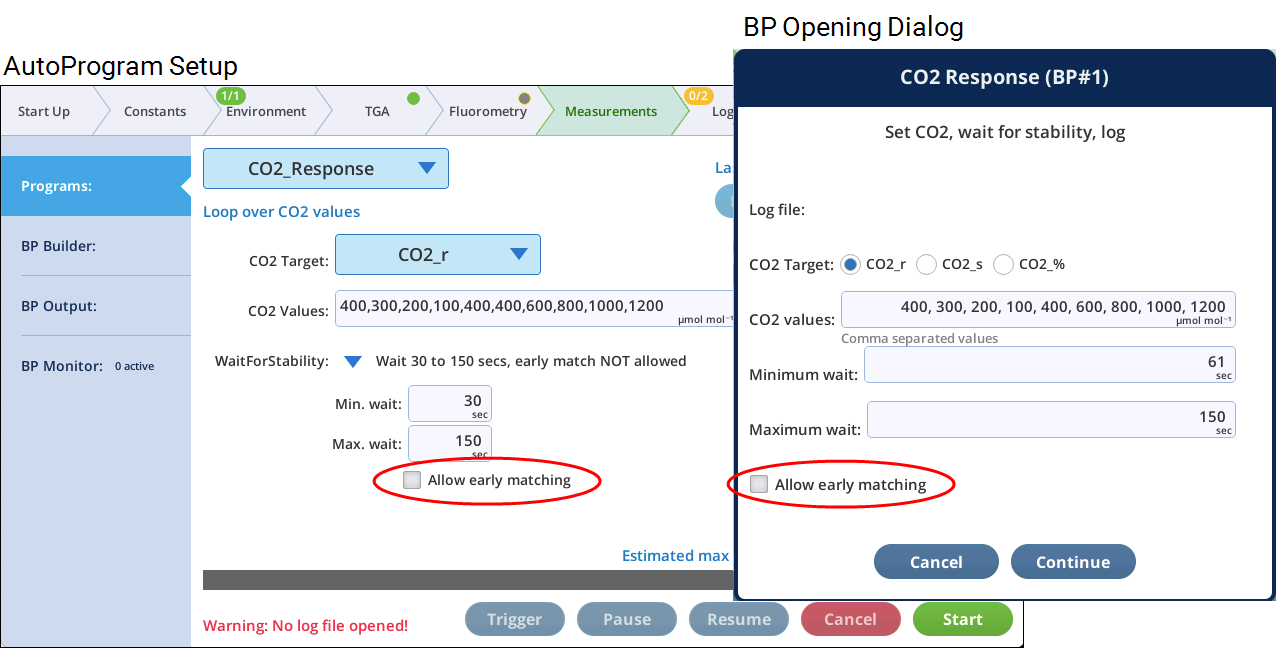
A number of Autoprograms and BPs have Early Matching as an option (Figure 12‑38). With TGA support enabled, and the flow source is the LI-6850 (as opposed to a tank), early matching will be ignored, whether you have asked for it or not. Early matching only accomplishes its goal of getting through a response curve more efficiently (faster) when the flushout/equilibration time for the gas analyzers is fairly short when leaving match mode. This is not the case with the TGA. With the longer flushout/equilibration times of the TGA, an early matching that provides enough recovery time after the match would actually make a response curve less efficient and slower.
Logging data
In light of the matching considerations discussed above, be very careful about logging at frequent, regular intervals while including the TGA. Remember that to get TGA reference values, match mode must be used. But matching with the TGA can take 2 or 3 minutes, depending on your averaging and stability settings.
However, you can log frequently without matching if the reference conditions are not changing. Suppose, for example, if you wish to log data every 15 or 30 seconds over some period of time to capture how the leaf adapts to a new set of conditions. You can accomplish this by doing those logs without matching. But bracket that log sequence (or at least precede it) with a log that has matching enabled, to capture TGA reference data.
Remember that anytime you change the incoming air flow gas mixture (CO2, and H2O), a match will be needed to the get TGA reference updated. This means controlling on reference, not sample, over the time period you wish to log without matching. If you are running the CO2 or H2O control system to maintain constant in-chamber values, then the potential for incoming changes is always present. For example, maintaining a constant sample cell CO2 while incident light changes means the reference CO2 will be changing to compensate for the leaf’s changing assimilation rate; that would not be an appropriate time to log without matching.
Averaging differences
LI-6800 variables are computed from a running average (set in Constants > System) that is typically 4 seconds. Displayed and graphed values exhibit this average, and logged values have a second option for further averaging. TGA variables need more averaging than 4 seconds, so are handled entirely differently. They have their own averaging time (set in TGA > Status) that is applied to the TGA_stats group and everything that follows from it. (The TGA_raw group has no averaging and updates at 1 Hz.) Logged TGA measurements and computations have no additional averaging. This means:
-
Displayed values of TGA measurements and computations will match logged values.
-
In dynamic situations (e.g., CO2 changing), the TGA measurements will seem sluggish because of this averaging.
TGA calibration checks
A well-calibrated TGA is, of course, necessary for good measurements. A zero cal (requires a zero tank and about 5 minutes) is fundamental, and should be done periodically (start with daily zeros). A span calibration (requires a tank known CO2 concentration and its major isotopologue per mille values, typically δ13C and δ18O). With two span tanks of differing concentrations, span and offset can be calibrated for the isotopologues.
These calibrations can be done independently of the LI-6800, but the LI-6800 does provide a GUI for launching cals, and the span or span and offsets cals can be done programmatically, opening the possibility of either calibrating, or at least checking the calibration of the TGA during an experiment (while, for example, the leaf is equilibrating to a new light level).
The LI-6800 firmware divides the TGA span tank calibrations into two separate parts:
-
Measure a span tank (captured in a Tank Measurement (TM) file).
-
Use one or more TM files to compute new calibration coefficients and apply them to the TGA (captured in an Applied Tank Measurement (ATM) file).
This allows an experimental protocol to include just step 1, for example, giving you a record of TGA drift without actually changing the TGA cal.
Isotopic calibration
An isotopic calibration should be measured at least daily, or anytime the LI-6800’s CO2 source is changed. During an experiment, TGA matching can go a long way toward compensating for drift and CO2-concentration dependent errors. And, measuring an isotopic calibration again at the end of an experiment provides a direct opportunity to evaluate how well the match adjusts did in keeping the cal "current".
Also, periodic checks during the experiment using a span gas (TM files, above) will help identify the source of any drift: TGA or CO2 source.
Logging options
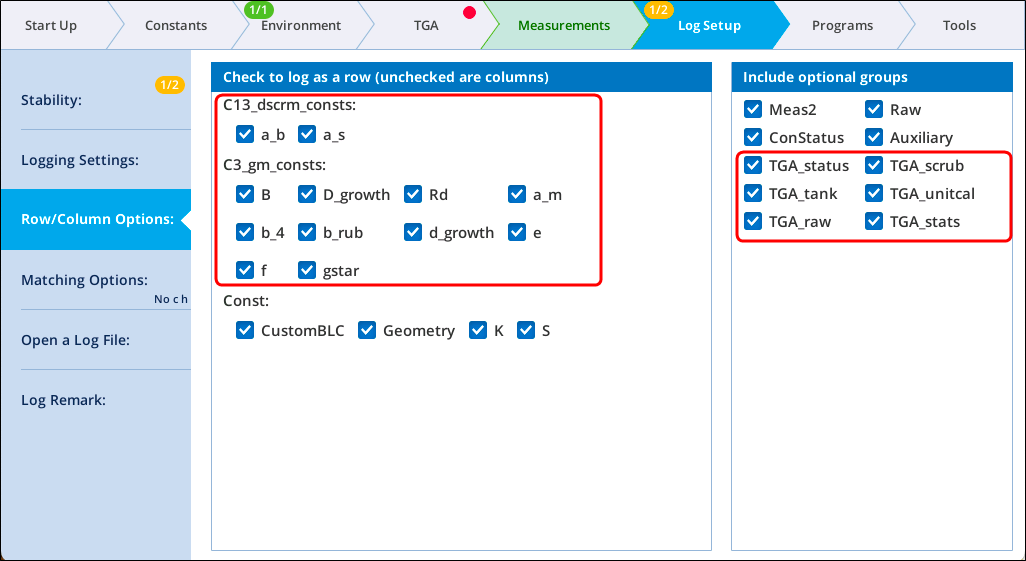
TGA support has a number of data groups that are optionally logged (Figure 12‑39). Also, the elements of the C3_Model group for mesophyll conductance can be logged as rows or columns in the data file. Row items (checked) appear once at the start of the log file, and not again unless their value changes. Column items (unchecked) appear on every row, changed or not.
Setting stability criteria for logging
There are two approaches to adding some measure of TGA stability to your stability criteria for logging.
-
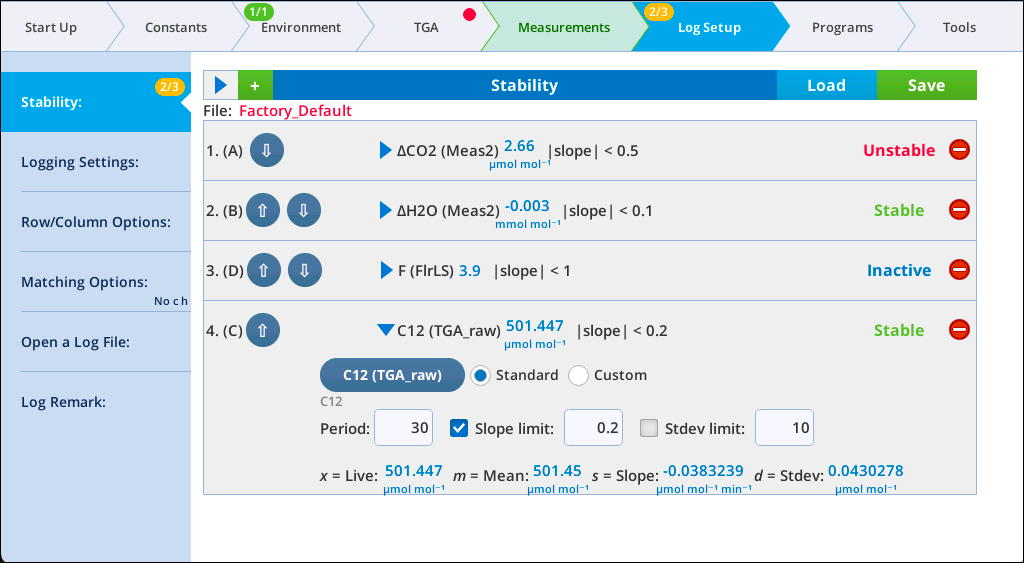
Traditional: Compute stats on some TGA measured quantity, such as (for LI-7825) C12 in TGA_raw (Figure 12‑40).
The obvious disadvantage of this approach is that there is nothing to keep this in sync with what you’ve defined for stability on the TGA Status page.
-
Smarter: Since you already have a measure of TGA stability defined on the TGA Status page, just add that flag to your stability criteria.
Version 2.2 allows for this sort of thing in stability definitions (Figure 12‑41).
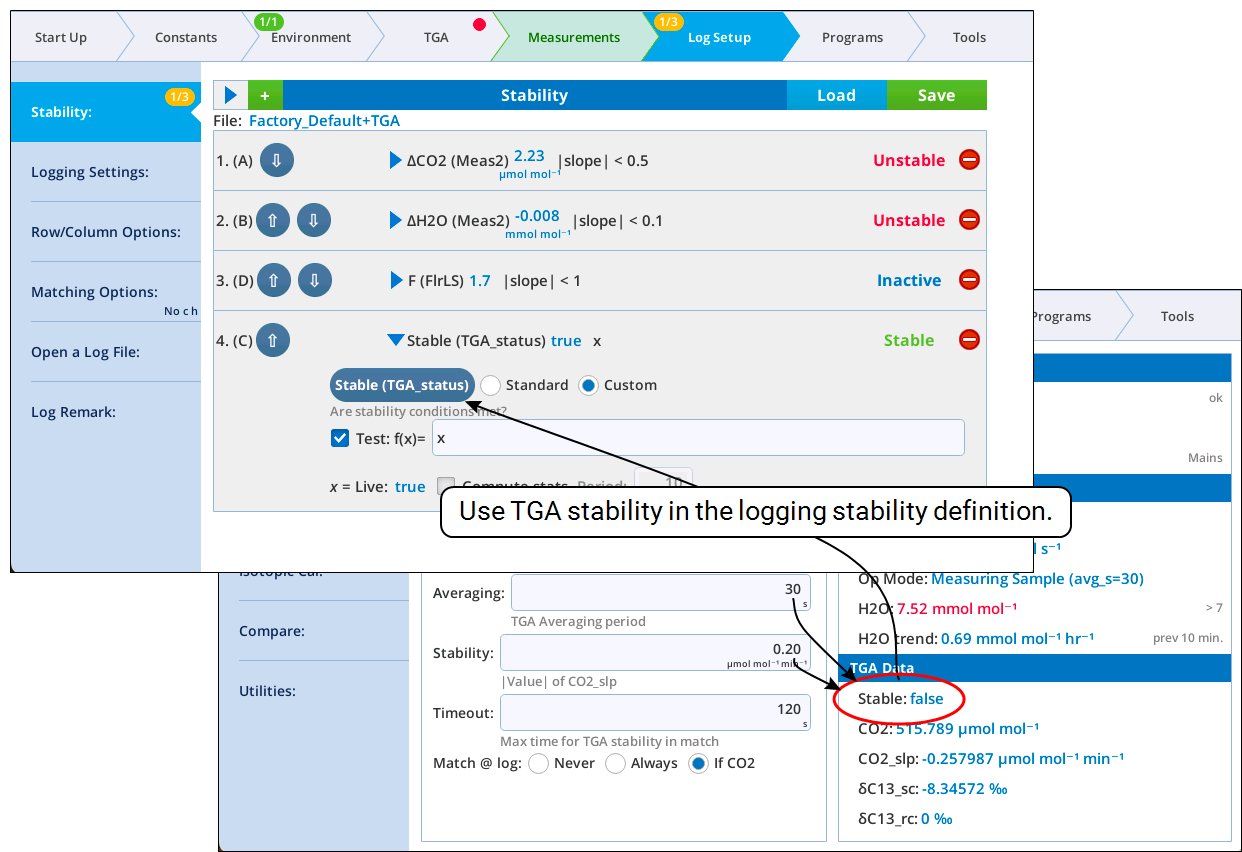
The file Factory_Default+TGA, shown in Figure 12‑41, is installed as part of the TGA support package and can be loaded via the Load button. Factory_Default+TGA, unlike Factory_Default, is not write protected, so can be modified by you. However, changes you make will be lost on any updates or re-installs of TGA support, so if you do make changes, you should save them under a new name.
If you add TGA-derived values (excluding the TGA_raw group) to the stability criteria, note that they are already averaged by TGA averaging time, so you may not need or want to do extra averaging on them in the stability list. In that case, use Custom instead of Standard, and leave the Compute stats box unchecked.
Low oxygen experiment
Sudden changes to major background constituents (oxygen, nitrogen) of the air being measured by the TGA can cause it to lose linelock and require a reboot. If you are planning to combine low oxygen LI-6800 experiments with TGA support, then consider using the utility program Gas transition to avoid having to reboot the TGA. This program will provide a slow transition from ambient air to low oxygen before you begin the experiments. When done, use the program again to transition back to ambient.